
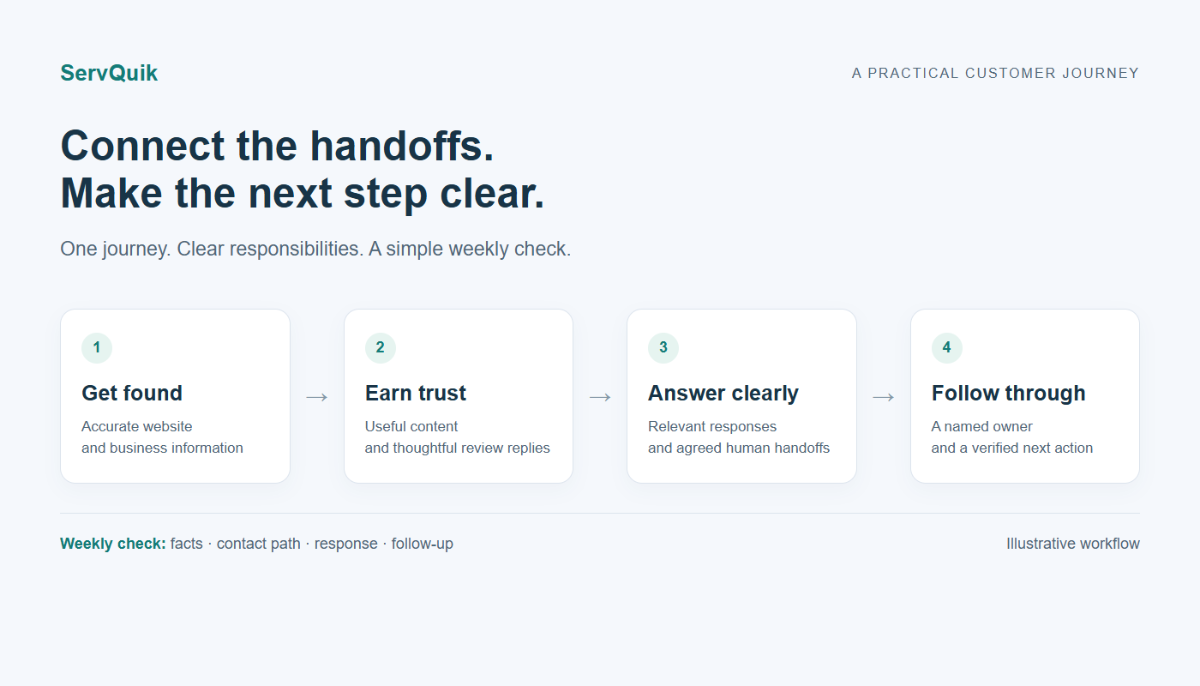
Running a small business can mean keeping a website, business profile, review inbox and incoming inquiries moving at the same time. Each activity has a purpose, but the handoffs between them can become difficult to follow. A service page may describe an old offer while a staff member gives a different answer on the phone. A customer may submit a form without knowing when someone will respond.
Coordinating growth work starts with making those handoffs visible. The practical goal is a consistent path from discovering the business to receiving a useful answer and taking the next step. This guide explains how to organize that path, what to prepare and what to check before relying on automation.
Start with the customer journey
Think about one real question a potential customer asks. A local service business might receive, “Do you work in my neighbourhood, and how can I get an estimate?” The website should explain the service area. The business profile should use current contact details. The inquiry process should collect enough information for someone to respond without promising an estimate that has not been prepared.
Draw the journey as four steps: find information, evaluate the service, ask a question and receive follow-up. For each step, write down the page or channel involved, the person responsible and the expected next action. This simple map often reveals a gap before another marketing task is added. A polished page is less useful when its contact button leads to an unattended inbox.
Keep one reference for business facts
Prepare a short, approved reference covering the business name, contact information, services, locations, hours and common customer questions. Separate confirmed facts from offers being considered. When a detail changes, identify every place that needs updating rather than relying on people to remember where it appeared.
For example, if a business changes its service area, the update may affect a service page, contact form, profile description and inquiry script. Record the change once, assign an owner and check the affected channels. This is an operating recommendation, not a guarantee that every directory will update immediately. Some services require a separate verification or review process.
Make content answer a useful question
An article should help its intended reader make progress. Choose a specific question, explain the answer clearly and add something practical: a checklist, decision rule or example. Google’s people-first content guidance recommends evaluating whether readers can accomplish their goal after reading, and cautions against producing content mainly to attract search visits.
A useful brief therefore includes the audience, question, evidence and next step. “What should I prepare before requesting an estimate?” is more actionable than a broad instruction to write about the industry. The business should supply the details that only it can confirm, such as its actual assessment process. Sources support general facts; they cannot establish an individual business’s unverified capabilities.
Connect reputation work to the same business voice
Review replies belong to the public customer experience. Google explains that approved replies appear publicly under the business and that the reviewer is notified. Keep responses respectful, relevant and consistent with how the business communicates elsewhere.
Define which replies can follow a standard process and which need a person. A straightforward thank-you may be suitable for an agreed automatic workflow. A disputed incident, sensitive complaint or request for a refund needs the business’s judgment. Avoid publishing private customer information or making a commitment that staff have not authorized. The objective is a thoughtful response, not a generic paragraph attached to every review.
Give every inquiry a clear next step
List where inquiries arrive and what should happen next. A website form, call or chat can each require a different response, but they should point toward the same agreed business process. Decide what information is needed, who receives it and when a person must take over.
Use a hypothetical estimate request to check the handoff. Can the customer describe the job? Does the right team receive the request? Does the acknowledgement accurately explain the next step? Is there a way to recover if delivery fails? Do not describe an acknowledgement as a confirmed appointment unless booking has actually completed. Clear status language helps both the customer and the staff member handling follow-up.
Where ServQuik fits
ServQuik describes its Growth System as a managed service connecting online presence, ongoing marketing and lead follow-up. The work and channels depend on the selected plan and account access. Its published approach includes quality review and configurable client approvals, while the client retains ownership of websites, approved content and business accounts.
For an owner evaluating this approach, the useful discussion is about responsibilities. Identify which channels need attention first, who supplies business facts, who approves sensitive content and how exceptions are handled. Ask to see the workflow for one representative customer journey before expanding it across the business. Coordination should make ownership and next steps easier to understand.
Use a practical weekly handoff check
Choose one journey and review it from a customer’s perspective. Open the relevant page on a phone, confirm its important facts and follow the intended contact path. Inspect a recent article or review reply for accuracy and tone. Then check whether the resulting inquiry reached the correct person.
Keep a short log with four fields: issue, owner, next action and verification. For example, “Estimate form acknowledgement unclear; office lead; revise wording; submit an authorized test after the change.” Close an issue only after checking the result. If a task fails, keep it visible and continue unrelated work; a single unresolved item should not silently stop the whole routine.
Key takeaways
- Map the handoffs between discovery, trust, inquiry and follow-up before adding more activity.
- Maintain one approved reference for business facts and record which channels need each update.
- Use automation for agreed routine work, with clear statuses and a recovery path for exceptions.
- Review one complete customer journey regularly instead of measuring activity alone.
If your website, marketing and inquiry follow-up feel disconnected, prepare that journey map and bring it to a ServQuik Growth Call. It gives the conversation a concrete starting point: the customer experience you want to improve and the responsibilities needed to support it.
Draft prepared with AI assistance for ServQuik’s editorial review. Business-specific statements and publication remain subject to the owner’s approval.
Sources
- ServQuik Growth System and FAQs — ServQuik
ServQuik describes a managed service connecting online presence, ongoing marketing and lead follow-up; scope depends on the plan, with client ownership and configurable approvals.
- Creating helpful, reliable, people-first content — Google Search Central
Evaluate content by whether intended readers can achieve their goal; avoid content produced mainly to attract search visits.
- Manage customer reviews — Google Business Profile Help
Approved replies are publicly posted as the business and the reviewer is notified.
About the author
ServQuik · Organization
ServQuik provides managed online presence, ongoing marketing and inquiry follow-up for small businesses.